
Movement Is Medicine: Why There Isn't One 'Best' Exercise for Back Pain
If you've ever searched online for exercises for back pain, you've probably been met with hundreds of videos claiming to show the "best stretch" or the "one exercise you need".
The truth is, there isn't one exercise that's right for everyone.
Back pain can have many different causes, and what helps one person may not be suitable for someone else. However, for most people with everyday back pain or stiffness, one thing is consistently recommended: keep moving.

Why Is Movement So Important?
When your back is painful, it's natural to want to rest. While a short period of rest may help if your pain is particularly severe, staying still for too long can actually make your back feel stiffer and weaker.
Gentle movement helps to:
Keep joints mobile.
Reduce muscle stiffness.
Improve circulation.
Maintain strength and flexibility.
Build confidence in moving again.
The key is to move regularly and comfortably, rather than pushing through pain.
There Isn't One "Perfect" Exercise
Every back is different.
A gardener with a stiff lower back, a runner recovering from an injury, and someone who spends all day at a desk may all experience back pain for different reasons.
Instead of searching for the perfect exercise, it's often more helpful to find movements that feel comfortable and encourage your back to keep moving.
Five Gentle Exercises That Many People Find Helpful
These exercises are suitable for many people with everyday back stiffness or mild mechanical back pain. Move slowly, stay within a comfortable range, and stop if your symptoms become significantly worse.
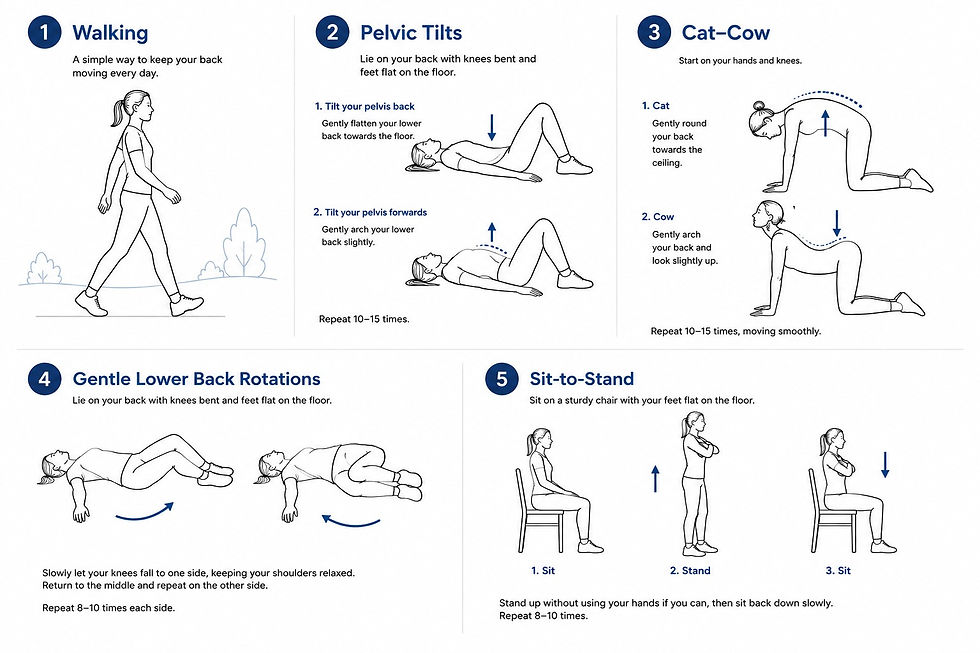
1. Walking
It may sound simple, but walking is one of the best ways to keep your back moving.
Even a 10-20 minute walk can help reduce stiffness, encourage blood flow and gently activate the muscles that support your spine.
Consistency is far more important than speed or distance.
2. Pelvic Tilts
Lie on your back with your knees bent and feet flat on the floor.
Gently rock your pelvis forwards and backwards, allowing your lower back to move naturally against the floor.
Repeat 10-15 times using slow, comfortable movements.
3. Cat-Cow
Start on your hands and knees.
Slowly round your back upwards before gently allowing it to arch the other way.
There's no need to force the movement - simply move as far as feels comfortable.
Repeat 10-15 times.
4. Gentle Lower Back Rotations
Lie on your back with your knees bent and feet on the floor.
Keeping your shoulders relaxed, slowly let both knees fall a short distance to one side before returning to the middle and repeating on the other side.
Move gently and only as far as feels comfortable.
5. Sit-to-Stand
Sit on a sturdy chair with your feet flat on the floor.
Stand up without using your hands if you can, then slowly sit back down again.
Repeat 8-10 times.
This simple movement helps maintain strength in your legs and encourages your back to move naturally during everyday activities.
Listen to Your Body
It's normal to feel a little stiffness when you first start moving, particularly if you've been inactive.
However, stop exercising and seek professional advice if you experience:
Severe or worsening pain.
Pain that travels significantly down your leg.
Numbness or weakness.
Changes in bladder or bowel control.
Pain following a significant fall or injury.
If you're ever unsure, it's always worth getting assessed before starting a new exercise programme.
The Best Exercise Is the One You'll Keep Doing
You don't need complicated routines or expensive equipment to look after your back.
For many people, gentle movement carried out regularly is one of the most effective ways to reduce stiffness and keep the back healthy.
If your pain isn't improving, keeps returning, or is affecting your daily life, it may be helpful to have it assessed so the underlying cause can be identified and the right treatment or rehabilitation plan can be recommended.
Any questions? Click here to get in touch with our team - we’re always happy to help.


Comments